 The public-private partnership envisioned by the qui tam provisions of the False Claims Act (FCA) is one of its most successful and powerful aspects, yielding billions of dollars in recoveries. The FCA permits the Government, the whistleblower, and their attorneys to cooperate—and they often do—when investigating and litigating FCA claims. But are there limits to that cooperation? Can government officials ask a whistleblower to secretly record conversations between the whistleblower and individuals who are under investigation but are represented by an attorney? The answer, according to one federal court, is “yes.”
Blog
 Older workers are one significant step closer to enjoying the same federal protections as other protected classes after the U.S. House of Representatives passed the Protecting Older Workers Against Discrimination Act (“POWADA”) on January 15, 2020. The Bill, if enacted, would amend the standard for employees alleging discrimination under the Age Discrimination in Employment Act, Title VII of the Civil Rights Act of 1964, the Americans with Disabilities Act, and the Rehabilitation Act of 1973.
In 2009, the United States Supreme Court decided in Gross v. FBL Financial Services, that in order for an employee to prove that an employer violated the Age Discrimination in Employment Act, an employee needed to show that he or she was terminated because of age.[1] Before Gross, age discrimination was treated just like discrimination based on other employee protected classes, such as race, color, sex, national origin, religion, or disability, which require an employee to prove that discrimination only played a role in the employer’s decision. POWADA would reverse the Gross decision and return older workers to the same playing field as other protected classes.
Applying for a job can be the ultimate test of one’s confidence, especially in light of a new study which found that employment interviews are more often given to candidates with current jobs or who were recently laid off, as opposed to those candidates who had been unemployed more than 26 weeks. In fact, many employers didn’t even consider jobless applicants, screening out their applications even before the interview stage.
Yet the subject of screening out applications can be a sensitive one. As a preliminary matter, the Minnesota Human Rights Act prohibits employers from requesting certain information from job applicants before they are hired. If an employer requests pre-employment information pertaining to an applicant’s race, religion, national origin, public assistance, sex, marital status, sexual orientation, age, creed, or disability, that employer may find itself subject to potential liability, save for a few codified exceptions.
 One of the first and most frequent arguments defendants make in fighting qui tam allegations under the False Claims Act (FCA) is that the case brought by the whistleblower, or “relator,” is not viable because it is based on publicly available information, the relator is not an “original source” of that information, or both. On February 19, 2020, the First Circuit Court of Appeals issued an important decision clarifying that to qualify as an original source, a relator need not have participated in the fraud or observed it in operation. Instead, a relator may qualify as an original source if the relator sees or receives information that is suggestive of fraud, hears suspicious conversations, and discovers additional evidence of fraud through personal investigation. United States ex rel. Banigan v. PharMerica, Inc., No. 18-1487, 2020 WL 813258, at *8-9 (1st Cir. Feb. 19, 2020).
 We often write about the more common protections for employees in Minnesota, such as protections against discrimination, sexual harassment, retaliation for reporting law violations (i.e. whistle blowers), and protections for employees who take medical leave. But, did you know that Minnesota also provides lesser-known protections to employees? For example, Minnesota law allows employees to take up to 16 hours of time off work to attend their child’s school conferences and activities each year and for each child.
 What rights does an employee have when jury duty calls?
This is a common question many Minnesotan employees have as they followed the media’s coverage of the high-profile case of Mohamed Noor, a police officer on trial for shooting Justine Ruszczyk (Damond) after she reported a crime being committed near her home. The trial started with jury selection on April 1, 2019, and lasted nearly a month. On April 30, 2019, the jury returned after 11 hours of deliberation and convicted Mohamed Noor of third-degree murder and second-degree manslaughter.
During the initial jury selection phase of the trial, many media outlets reported the court dismissing numerous jurors for various reasons, such as bias, but also because of financial hardship. For example, the court excused several potential jurors because they could not find/afford childcare or could not afford to miss a paycheck (let alone a month of work).[1]
 Employee misclassification has become a huge problem in the United States. Employers who want to increase profits by not paying withholding and other taxes and escaping liability for workers’ compensation and unemployment claims will often claim that their workers are ‘independent contractors’ or ‘consultants’ (ICs), even though these people perform jobs that go to the heart of the employer’s business.
As an example, it has become almost automatic for operators of trucking, courier, and delivery services to use only independent contractor drivers. Why? The answer is simple- they save hundreds, maybe millions, of dollars each year by stiffing workers of benefits like 401(k) matches, insurance coverage, overtime, etc.
For many years now companies have largely gotten away with this intentional misclassification by requiring workers to sign agreements with arbitration clauses and class action waivers. When workers challenged misclassification they were required to do it individually, rather than as part of a larger group of workers, and had to submit their claim to an arbitrator rather than a judge (arbitrators often coming from the ranks of lawyers that defend corporations). As a result, it became almost impossible to succeed in these types of cases. However, the tide has finally turned.
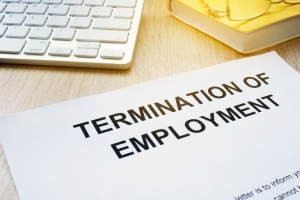 You’ve just been fired, or you suspect you’re about to be fired. And you think that your termination may be for an illegal reason (e.g., discrimination, retaliation, blowing the whistle). Now what?
1. Do Not Quit / Do Not Sign Anything. Most workers who suspect termination is imminent often believe it is better to quit than be fired. But depending on the circumstances, that might not be true. Voluntarily leaving your position before your employer takes any adverse employment action against you (e.g., a termination), could weaken your ability to make an employment claim. Often it is wiser to continue to do your job well, which means that your employer will have to terminate you to make you leave. However, there could be extenuating circumstances that would warrant a different decision. If you are tempted to quit your job, it would be wise to contact an employment attorney before quitting to discuss your particular situation and your options.
At your termination meeting, your employer may present you with a document called a separation or severance agreement, potentially with an offer of some amount of money. Again, the wise thing to do is to consult with an attorney before signing anything. If you signed this document already and are having second thoughts, you should immediately contact an employment attorney to review the agreement on your behalf. If you act quickly enough, you may be able to rescind your agreement.
 Although Minnesota is an “employment at-will” state—meaning the employer may terminate an employee at any time for any reason—there are, in fact, exceptions to the rule. Since 1967 the Minnesota Human Rights Act has served as the State’s comprehensive employment rights law and provides a wide range of protections for employees. Yet even with the law in place, employers continue to violate employees’ rights in countless ways. Here are 20 of the most common violations for which an employee may seek monetary relief under the Minnesota Human Rights Act:

Sexual harassment or sexual assault can be actionable if it occurs on business travel or at work-related events. In fact, over half of the sexual assault cases we have handled involved assaults that occurred outside of the office and outside of work hours. If the harassment or assault can be shown to be related to the employment relationship and the incident is sufficiently severe or repetitive, you may have an actionable claim against your employer.
Minnesota law prohibits discrimination in employment on the basis of sex, including sexual harassment. Sexual harassment “includes unwelcome sexual advances, requests for sexual favors, sexually motivated physical contact or other verbal or physical conduct or communication of a sexual nature when . . . that conduct or communication has the purpose or effect of substantially interfering with an individual’s employment . . . or creating an intimidating, hostile, or offensive employment . . . environment.” Minn. Stat. § 363A.03, subd. 43(2).