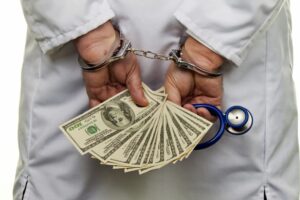
pharmaceutical and medical kickbacks prohibited halunenlaw.comThe False Claims Act (FCA) is designed to combat and prevent healthcare fraud, including pharmaceutical or medical providers that illegally solicit or accept kickbacks [1].

Persons who become aware of illegal solicitation or acceptance of kickbacks in the healthcare industry can act as a whistleblower on behalf of the government and file an FCA lawsuit. Under the “qui tam” provisions of the FCA, these individuals can receive financial compensation for their efforts and legal protection from retaliation. In many cases, individuals who report kickbacks and other forms of healthcare fraud are current or former employees, patients, or others with unique opportunities to know about the alleged misconduct. They are motivated by a desire to do what is right. Whistleblowers thus serve an integral role in protecting patients, American taxpayers, and the integrity of our nation’s healthcare system.

Why are Kickbacks Illegal?

The primary reason why kickbacks are illegal in the healthcare industry is that they have a potent ability to interfere with a healthcare provider’s independent judgment resulting in treatment decisions that are made to serve the provider’s interest rather than the best interest of the patient. For example, a Yale study[2] found that cardiologists were between two and 11 times more likely to implant a defibrillator made by the device company that paid them the most money compared to physicians who did not receive payments. Another study showed that giving physicians even one free meal during which a particular drug was discussed resulted in a higher prescription rate. [3]

Accordingly, kickbacks are illegal for many reasons:

    • Kickbacks compromise the quality of patient care.
    • Kickbacks induce health care providers to consider their own interests before those of their patients.
    • Kickbacks drive up health care costs for patients and health insurance providers.
    • Kickbacks lead to medically-unnecessary treatments, medications, and other supplies/services.
    • Kickbacks and other forms of health care fraud cost taxpayers billions of dollars each year. [4]

In one of the largest health care fraud cases in American history [5], the government recovered $1.7 billion from HCA Inc., a provider that engaged in several unlawful practices, including providing kickbacks. This landmark case was sparked by nine FCA lawsuits brought by whistleblowers who ended up receiving a combined share of more than $151 million in financial rewards. These nine people helped initiate a course of action that ended the provider’s shocking record of criminal activity and fraud.

Federal Laws Prohibiting Kickbacks in Healthcare

While the FCA provides a process for whistleblowers to file lawsuits on behalf of the government, there are two specific federal laws that make healthcare kickbacks illegal in the United States—the Anti-kickback Statute (AKS) and the Stark Law. Violations of both these laws can be prosecuted under the FCA.

The Anti-Kickback Statute, 42 U.S.C. § 1320a–7b(b)

The AKS is one of several fraud and abuse laws that apply to the healthcare industry. [6]
The AKS makes it illegal to offer, solicit, or accept anything of value to motivate or reward referrals in any capacity. Essentially, a medical provider or company is committing fraud when incentives are provided to encourage the use of certain products or services for which payment is made via federally-funded programs, such as Medicare, Medicaid, and Tricare.

Examples of kickbacks include:

    • Cash payments
    • Gifts
    • Travel and entertainment
    • Free or discounted services or supplies


It is not unusual for organizations and providers to disguise illegal kickbacks as legitimate medical payments. For example, a pharmaceutical company may hide illegal activity by paying a doctor an inflated rate for a speaking engagement. Regardless of the basis of a specific payment, the arrangement as a whole can still be categorized as fraudulent if its intent is to influence behavior.

Both the payers and recipients of kickbacks can be prosecuted under the AKS. Penalties for kickbacks can include criminal and civil measures, including fines, jail, and removal from federal healthcare programs. A conviction does not require the government to prove that the conduct harmed patients or caused financial loss.

Violations of the AKS can be prosecuted under the FCA and may result in an award of damages up to three times the full amount the government paid for the kickback-tainted products or services as well as civil penalties.

The Stark Law, 42 U.S.C. § 1395nn

The Stark Law focuses specifically on physicians. It prohibits them from referring Medicare/Medicaid patients to medical providers for particular health services if the referring doctor has a financial relationship with that provider. Financial relationships include ownership, investment interests, or other compensation arrangements. Unless an exception applies under the Stark Law, it is illegal to make these referrals and submit claims for any payments related to these prohibited referrals.

Violations of the Stark Law can be prosecuted under the FCA and may result in an award of damages up to three times the full amount the government paid for the Stark-tainted services as well as civil penalties.

Key Difference between the Anti-Kickback Statute and the Stark Law

The most important difference between the Anti-Kickback Statute and the Stark Law is each law’s focus.

The Anti-Kickback Statute covers referrals from anyone for any services or items paid for by any federal healthcare programs. However, the Stark Law is more specific, focusing on referrals from a physician made for designated health services under Medicare or Medicaid.

Under both of these federal laws, violations can also be considered a violation of the FCA. Therefore, individuals with knowledge of AKS or Stark law violations can bring a “qui tam” lawsuit through the FCA.

Report Medical Kickback Schemes and Stark Violations through the FCA with Help from Halunen Law

If you suspect a healthcare provider of soliciting or accepting illegal kickbacks, Halunen Law can review your case and provide professional guidance about next steps to take and whether a False Claims Act case may be viable.

Our False Claims Act attorneys at Halunen Law practice nationwide, advocating for whistleblowers who speak up against healthcare industry misconduct. With extensive expertise and a proven track record of success, the anti-kickback lawyers at Halunen Law are well-equipped to protect you from illegal retaliation and ensure the best possible outcome.

If you feel you’ve experienced illegal action in your workplace, we encourage you to submit a Case Review Form to our firm. One of our attorneys will review your information, and you’ll receive a response from our firm in a timely manner. There is no charge for this confidential process. And, if we take your case, as a contingency-based law firm, there is no cost unless we win.

We’re here to help you navigate your lawful rights and ensure you get the treatment you deserve. Together, we can hold employers accountable and create a fairer workplace for everyone.


Sources:
[1]  https://www.justice.gov/civil/false-claims-act
[2] https://www.icij.org/investigations/implant-files/heart-doctors-more-likely-to-implant-devices-from-manufacturers-that-pay-them-new-study-finds/
[3] https://www.nbcnews.com/health/health-news/free-lunches-pay-drug-companies-study-shows-n595906
[4]  https://www.cms.gov/Outreach-and-Education/Medicare-Learning-Network-MLN/MLNProducts/Downloads/Fraud-Abuse-MLN4649244.pdf
[5]  https://www.justice.gov/archive/opa/pr/2003/June/03_civ_386.htm
[6]  https://oig.hhs.gov/compliance/physician-education/fraud-abuse-laws/


Featured Image: Lisa-S / Shutterstock

upcoding and unbundling in healthcare fraud halunenlaw.comUpcoding and unbundling in healthcare are two forms of improper medical coding. Both fall under the federal government’s definition of healthcare fraud when the government is paying for the care and can be pursued through the False Claims Act.

With serious implications that can cause harm to patients, taxpayers, and the American healthcare system as a whole, fraudulent practices such as these are aggressively investigated, prosecuted, and penalized.

What is Upcoding?

Considered a serious form of fraud, upcoding occurs when a healthcare provider inflates bills to the government by submitting false medical codes to Medicare, Medicaid, TRICARE, or other government payers—that is, the provider bills for diagnoses and services that are more serious and expensive than the actual services rendered.

Many kinds of healthcare providers have been investigated for upcoding, including physicians, healthcare facilities, providers of home health care, physical therapy providers, and even entire healthcare networks.

Providers and insurers use billing codes to communicate the services provided to various patients. Each billing code corresponds to a specific diagnosis or service while simultaneously labeling the complexity of work required by the provider and, thus, the associated costs. Government (and private) insurers use these billing codes to calculate and issue payments to healthcare providers.

The consequences of upcoding are serious and affect both the patients involved and insured patients as a whole. Because upcoding leads to an unnecessary increase in insurer spending, it can be a catalyst for increased rates or reduced coverage. In addition, upcoding involving government payors such as Medicare and Medicaid steal vital funds from taxpayer-funded healthcare programs. On an individual patient level, upcoding fraud has an impact on the integrity of a patient’s medical records and may prevent them from receiving proper care in the future.

Doctors and Upcoding

All doctors must document provided care and services and then utilize standardized medical billing codes to bill insurers for the procedure(s). This expectation applies to both primary care and specialty physicians.

Doctors engage in upcoding when they manipulate medical coding to obtain financial compensation that exceeds what they have fairly earned. There are generally three types of upcoding fraud committed by doctors

    • A physician may perform a simple, routine procedure, then use a different code to indicate that a more complex (and higher-paying) procedure was completed.
    • A physician may use incorrect Evaluation & Management (E&M) codes to suggest that a patient’s visit required more of their time/expertise than it actually did.
    • A physician may attempt to apply modifier codes to bill for specific additional services, despite those services being covered under the standard code for the visit in question.

Hospitals and Upcoding

Upcoding can also occur on a larger scale, such as at the hospital/healthcare facility level. The costs associated with hospital-provided inpatient care are governed using pre-determined rates, which depend on the diagnosis-related group (DRG) to which they belong. The DRG is directly tied to the severity of a patient’s diagnosis, as well as the type of stay they require, which are determined according to diagnosis codes (ICD codes).

Two of the most common types of upcoding committed by hospitals are:

    • When a hospital bills for physician-provided care, even though the care was actually provided by a lower-paid professional, such as a nurse or physician’s assistant
    • When a hospital bills an inpatient stay at the highest-possible severity level, even though the patient received routine care with no secondary diagnosis, major complication, or comorbidity (additional patient condition).

Upcoding and Other Healthcare Providers

In addition to doctors and hospitals, upcoding fraud can also be committed by other entities. For example, federal medical fraud cases include upcoding carried out by urgent care facilities, home healthcare agencies, and durable medical equipment (DME) providers.

What is Unbundling?

Another form of improper medical coding and fraud is unbundling, also referred to as “fragmentation.” This fraudulent activity most commonly occurs in bills submitted to Medicare and Medicaid because the federal insurers often provide lower reimbursement rates for specific types of medical procedures that tend to be performed together. For example, incisions and closures related to surgical procedures will be bundled or combined with the procedure itself – or multiple blood tests from a single specimen will be bundled at a specific billing amount. Typically, the total reimbursement rate will be lower than it would have been for the procedures billed separately.

Unbundling in medical coding occurs when a healthcare provider fragments or unbundles billing codes to receive a higher reimbursement amount. Providers may utilize electronic health records (EHR) software to falsify treatment notes or alter the displayed codes, thus justifying the unbundled billing at the higher rate.

Like upcoding, unbundling is an act of fraud committed against the federal government. It carries serious penalties that can include fines, loss of medical license, and jail time.

Reporting Upcoding and Unbundling or Other Forms of Healthcare Fraud under the False Claims Act

Medical upcoding fraud and unbundling fraud are illegal, can cause patient harm, and line the pockets of those who would cheat the government at the cost of government health systems and all taxpayers. The Government relies on persons with knowledge of upcoding or unbundling, such as employees, coding personnel, and even patients themselves, to bring these illegal practices to light when they involve government-provided healthcare.

Persons with knowledge of upcoding or unbundling may challenge this illegal coding conduct by bringing a lawsuit under the False Claims Act. The FCA is a federal statute designed to reward whistleblowers who bring “qui tam” lawsuits against companies and individuals defrauding the government. If the Government succeeds in getting money damages or civil penalties from the coding claim, the person reporting the fraud is generally entitled to between 15-30% of the money recovered. Additionally, the False Claims Act can protect whistleblowers from retaliation for reporting the illegal conduct.

The Government may also prosecute upcoding or unbundling criminally, and a conviction can result in severe penalties. Fines, revocation of medical licensure, and jail time are all possible outcomes of a conviction.

Private individuals must be represented by counsel to file an FCA lawsuit. If you are aware of upcoding, unbundling or other types of federal fraud, your first step should be to contact a law firm with deep experience in bringing False Claims Act lawsuits. Most FCA attorneys work on a contingency basis, meaning that you pay nothing unless your case is successful.

The healthcare fraud attorneys at Halunen Law have worked extensively with cases such as these, providing legal expertise, advocacy, and protection to the courageous individuals that speak out against corporate fraudulent conduct. Every case is unique, but we have built the experience and skill necessary to fight on your behalf.

If you feel you’ve experienced illegal action in your workplace, we encourage you to submit a Case Review Form to our firm. One of our attorneys will review your information, and you’ll receive a response from our firm in a timely manner. There is no charge for this confidential process. And, if we take your case, as a contingency-based law firm, there is no cost unless we win.

We’re here to help you navigate your lawful rights and ensure you get the treatment you deserve. Together, we can hold employers accountable and create a fairer workplace for everyone.

SusanC-2Susan Coler, a partner in the Halunen Law False Claims Act/Whistleblower practice group provided private and government contract law attorneys her thoughts on “Navigating the False Claims Act: Protecting Your Client’s Business, Whistleblowers, and Tax Dollars” at a day-long CLE on January 20, 2022. Titled Government Contract Law: Fundamentals and Hot Topics, the CLE was chaired by Tom Radio and sponsored by Minnesota CLE. It included presentations by persons involved in all aspects of state and federal government contracting from both the contractor and the government sides.

Coler’s presentation focused on the value of the False Claims Act as protecting honest businesses, taxpayers, and those people impacted by the government’s contracts (e.g., persons on Medicaid, military personnel, and anyone who uses infrastructure paid for by the government). She further noted that emerging trends in fraud and government contracting warrant attention to cybersecurity, buying American, and ensuring that only authentic small business seek small business set-asides. Finally, Coler encouraged all present to view employee whistleblowers as critical to the detection of fraud because they are in a position to see fraud that might otherwise go undetected. She suggested that employers will benefit significantly if they create a work environment where employees are protected from retaliation and taken seriously when they report suspect conduct.

Conference presenters and attendees uniformly recognized that the Infrastructure Investment and Jobs Act holds great potential for the growth of new and small businesses and the economy in general, and great risk at the same time of significant fraud from those who seek profit through cheating the government. Hence the emphasis of the conference on procurement integrity and avoiding situations that could result in False Claims Act claims against individuals and companies.

It was announced yesterday that the CEO of Insys Therapeutics Inc., Micheal Babich, pleaded guilty to participating in a nationwide scheme to bribe doctors to prescribe its opioid medication Subsys. Babich resigned as the Arizona-based drugmaker’s CEO in 2015. His guilty plea comes just weeks before Insys founder, and one-time billionaire, John Kapoor goes to trial facing allegations of racketeering conspiracy. Read More…

HalunenLaw-10Susan Coler, whistleblower attorney at Halunen Law, provides comments to Bloomberg Law regarding recent statutory amendments to the False Claims Act introduced by Republican Senator Chuck Grassley (R-Iowa).

“Shifting the materiality burden from plaintiffs to defendants will allow whistleblowers to more easily establish that a bad actor’s conduct could influence a decision maker in deciding to do business with them, said Susan M. Coler, who represents whistleblowers with Halunen Law in Minneapolis.”

Susan Coler’s comments were accompanied by commentary from False Claims Act attorneys Eric Havian of Constantine Cannon LLP, Joel Androphy of Berg & Androphy, and Vincent McKnight Jr. of Sandford Heisler Sharp LLP.

Read the full article.

HL Scales of JusticeIn recent The Globe article, courageous employee reflects on actions that led to employer’s 14-count conviction.

Whistleblower Jen Erikson knew something was amiss at her place of employment. Witnessing the business practices at Caring and Compassionate Healthcare Agency (CCHCA), she realized things didn’t add up. She started digging deeper and discovered systemic fraud taking place in the company’s Medicaid billing. Erickson contacted Halunen Law, and attorneys Susan Coler and Nathaniel Smith felt a case could be made under the False Claims Act. Read a full recounting of this story by The Globe , as Erickson reflects on the steps she took to put a stop to the theft of taxpayer dollars, the victimization of the already vulnerable people CCHCA served, and the eventual conviction of her employer.

On June 24, 2021, Ms. Brown was sentenced to nearly 8 years in prison and ordered to pay restitution of more than $1.8 million.

You can also read more in the Star Tribune article: “Former SW Minnesota care agency operator sentenced to nearly 8 years for cheating Medicaid out of $1.8M“

Halunen Law – Avoiding Orange Jumpsuit Worldwide Corporate FraudMINNEAPOLIS (May 13, 2021) – On the evening of May 11, 2021, a jury in southwestern Minnesota rendered a guilty verdict against Remona Lysa Brown on 14 felony counts of aiding and abetting healthcare fraud during her tenure leading the Caring and Compassionate Healthcare Agency LLC (CCHCA) in Worthington Minnesota.

The jury found that Brown submitted fraudulent claims to Minnesota’s Medicaid program for home care health services in amounts exceeding $1.8 million, for which restitution is sought.

The case began when a civil False Claims Act (FCA) lawsuit was filed by Halunen Law on behalf of a former employee and former client of CCHCA. These whistleblowers, called Relators in the FCA civil case, identified suspicious billing activity related to the private duty nursing services being provided by the agency.

They compared hours the employee actually worked to the Explanation of Medical Benefits (EOMB) received by the client from the Minnesota Department of Human Services for what was being billed and discovered that CCHCA and Brown were falsely billing for many more hours than were worked.

After the civil FCA lawsuit was filed, which is still pending in Minnesota federal court, and lengthy investigation, the Minnesota Attorney General’s Office chose to move forward with criminal charges against Brown.

The investigation found not only evidence supporting the allegations brought in the civil FCA suit, but also identified additional persons for whom Brown and CCHCA were fraudulently billing Medicaid.

Besides overbilling and billing for services never provided, the investigation found that CCHCA billed services provided by Licensed Practical Nurses and Personal Care Assistants as though they were being provided by Registered Nurses, resulting in higher payments than warranted.

“When it became clear to me that an injustice was happening, I knew I had to do something. In the medical field, we pledge to do no harm and it was horrifying to know that these people were being taken advantage of in their most vulnerable state.

I am so grateful to Halunen Law for listening to our story and taking the right measures so true justice could be served. I never thought I would be a whistleblower, but unless people bring attention to the wrongs in the world, they will persist. I encourage anyone who is witnessing fraud to come forward.” said Jen Erikson, the whistleblower in the case.

Both FCA Relators testified as witnesses in Brown’s criminal trial.  Their testimony and the additional evidence put forth by the State ultimately resulted in the conviction of Brown on all charges. On June 24, 2021, Brown was sentenced to almost 8 years in prison and order to repay over $1.8 million in restitution.

“The jury’s verdict gives us great satisfaction. Our clients started their civil FCA case with the goal of stopping healthcare companies who prey on their most vulnerable clients by using them to commit fraud against the government,” said Nathaniel Smith, an attorney with Halunen Law. “Thanks to their willingness to shine a light on CCHCA’s conduct and the work of the Minnesota Attorney General’s Office in successfully prosecuting this case through a jury verdict, their goal was achieved. The actions of these two courageous whistleblowers made a difference.”

Further details of the case can be found under court file number 53-cr-17-852.

Read more in the Star Tribune article: “Former SW Minnesota care agency operator sentenced to nearly 8 years for cheating Medicaid out of $1.8M”

About Halunen Law

With offices in Minneapolis, Chicago, and Phoenix, Halunen Law offers experienced legal representation to employees, whistleblowers, and those who have been wrongfully injured. Halunen Law has achieved a reputation as a fearless, tenacious, and successful plaintiffs’ law firm, with a laser focus on achieving justice for its clients. For more information visit halunenlaw.com.

If you feel you’ve experienced illegal action in your workplace, we encourage you to submit a Case Review Form to our firm. One of our attorneys will review your information, and you’ll receive a response from our firm in a timely manner. There is no charge for this confidential process. And, if we take your case, as a contingency-based law firm, there is no cost unless we win.

We’re here to help you navigate your lawful rights and ensure you get the treatment you deserve. Together, we can hold employers accountable and create a fairer workplace for everyone.

red-whistle-headA recent decision out the 6th Circuit reinforces that former employees are protected from retaliation under the False Claims Act – even when the retaliatory conduct happens after they are fired or leave the company.

In the lawsuit, an employee alleged he was “marginalized” for insisting on compliance with the law during his employment and then “blacklisted” in his industry after being fired. He filed an FCA case that the hospital where he had been working was providing illegal kickbacks to physicians in exchange for referrals – conduct that would clearly violate the False Claims Act. The employee applied to nearly 40 different companies and alleged the hospital’s retaliatory conduct kept him from successfully securing new employment.

The anti-retaliation provision of the FCA provides that any employee, contractor, or agent shall be entitled to all the relief necessary to make them whole if they are a) discharged, b) demoted, c) suspended, 4) threatened, 5) harassed, or 6) in any other manner discriminated against regarding the terms and conditions of their employment for acts done to stop violations of the FCA.

According to the 6th Circuit, these protections are broad and far-reaching – even so far as to reach former employees: “the anti-retaliation provision of the FCA may be invoked by a former employee for post-termination retaliation by a former employer.”

In making the decision, the Court noted that the purpose of the FCA’s anti-retaliation provision is to encourage the reporting of fraud and facilitate the federal government’s ability to stop fraudulent conduct by protecting those who assist in its discovery and prosecution. The Court further said: “If employers can simply threaten, harass, and discriminate against employees without repercussion as long as they fire them first, potential whistleblowers could be dissuaded from reporting fraud against the government.”

Employees are entitled to significant damages when their employees retaliate against them in violation of the FCA. In fact, they are “entitled to all relief necessary to make that employee whole.” Most notably, and unlike many other employee protections, current and former employees may receive double back-pay damages under the FCA. This amount can be large, especially when an underlying FCA case may go on for years while the government litigates the matter. Employees may also be entitled to reinstatement, front pay, emotional distress, other special damages, and their attorneys’ fees and costs.

The 6th Circuit decision is controlling authority in the states of Michigan, Ohio, Kentucky, and Tennessee. The 10th Circuit has ruled that the FCA does not cover former employees. This ruling applies in Oklahoma, Kansas, New Mexico, Colorado, Wyoming, and Utah. Other circuits have not yet taken a position on this issue, but this new ruling will make the argument more compelling in circuits that haven’t yet decided.

For many current or former employees facing retaliation after reporting fraudulent conduct or insisting that their employer follow the law, their rights are now more strongly protected. If this situation applies to you, you should contact an experienced attorney with deep knowledge of the False Claims Act and employment law. At Halunen Law we have both.

Download a PDF of the 6th Circuit Decision
Clay Halunen

The founder of Halunen Law, Clayton Halunen spent more than 25 years as a trial lawyer seeking justice for employees, from delivery drivers to CEOs, in individual, class action, and whistleblower cases. Raised in northern Minnesota by parents who both experienced workplace discrimination, he built his career holding powerful companies accountable for illegal conduct, including some of the largest corporations in the country. His work includes a $1.5 billion settlement in a pharmaceutical fraud False Claims Act whistleblower lawsuit. Learn more about Clayton Halunen.

Halunen Law employment attorneys Amy Boyle and Colin Pasterski recently filed suit on behalf of Din Dol, alleging the Minneapolis Fire Department engaged in racial discrimination and retaliation against the firefighting recruit. Cadet Dol was on a path to become the city’s first Somali-American firefighter.

The suit alleges Dol was subjected to “outward aggression” by classmates and supervisors, including a physical assault.  and was ultimately fired as retaliation for conveying his concerns.  After experiencing “increased hostile treatment” and reporting his concerns to department leadership, he received negative training feedback.

He was fired on February 21, 2020, less than one month before his anticipated graduation date, even though he had passed two certification exams. The complaint cites a history of racial discrimination against people of color. As of 2016, more than 70% of the department’s firefighters were white—a percentage that has only increased in recent years.

“It is an honor to represent Din Dol,” said Halunen Law employment attorney Colin Pasterski. “This case shines an important spotlight on the underrepresentation of Somali Americans and other people of color in the Minneapolis Fire Department.

Halunen Law has a long-standing history of bringing not only justice but societal change through successful litigation. We hope this case will have a profound impact on the Minneapolis Fire Department’s practices in the future and look forward to helping our client achieve resolution of this matter.”

Din Dol is represented by Halunen Law employment attorneys Colin Pasterski and Amy Boyle.

Read the Complaint filed in Hennepin County

Read recent coverage of this story in the Star Tribune and Associated Press

About Halunen Law

With offices in Minneapolis, Chicago, and Phoenix, Halunen Law offers experienced legal representation to employees, whistleblowers, and those who have been wronged. Halunen Law has achieved a reputation as a fearless, tenacious, and successful plaintiffs’ law firm, with a laser focus on achieving justice for its clients. For more information visit halunenlaw.com. 

Whistle On American FlagThe Department of Justice’s 2020 data is here, and it paints another compelling picture of the value brought by whistleblowers who file cases under the False Claims Act (FCA). In 2020, claims filed by whistleblowers were responsible for about 75% of new cases filed and about 75% of government fraud proceeds. And rewards made to whistleblowers in 2020 averaged about 18% of the proceeds collected by the government.

These conclusions are the results of DOJ’s annual collection and publication of data about the year’s filings under the FCA, as well as the amounts collected by the government. DOJ recently published the data for 2020 in a spreadsheet that provides information dating back to 1986, when the FCA was significantly strengthened. The data presents total filings, filings related to the Department of Health and Human Services, filings related to the Department of Defense, and all other filings.

What does the data show?

The 2020 data shows that whistleblowers played a critical role in prosecuting fraud against the government:

  • Whistleblowers filed 672 new qui tam cases, compared to 250 new cases filed by the government, for a total of 902 new cases.
  • Prior cases filed by whistleblowers resolved in 2020 yielded $1.68 billion compared to $545 million resulting from government-filed cases for a total of $2.31 billion collected under the FCA.
  • Whistleblower rewards amounted to more than $300 million.

The 2020 data shows that fraud related to health care led the pack for both new cases and recoveries:

  • 68% of new qui tam cases related to health care fraud.
  • 5% of new qui tam cases related to Department of Defense fraud.
  • 27% of new qui tam cases related to other kinds of fraud against the government.
  • 5% of recoveries related to health care fraud (note: this data does not include state recoveries for Medicaid fraud, which are also extensive).
  • 6% of recoveries related to Department of Defense fraud.
  • 9% of recoveries related to other kinds of fraud against the government.

The 2020 data shows that fraud has many, many faces.

The Department of Justice press release regarding 2020 data provides an overview of significant cases for the year. It highlights illegal kickbacks for drug and medical device prescribers, illegal payment of co-pays for expensive drugs, opioid-related cases, bid-rigging, bribery, and providing false information related to government purchases. Within health care alone, fraud encompasses a vast gamut of cases ranging from pharmaceuticals and medical devices to managed care providers, hospitals, pharmacies, hospices, laboratories, and physicians, and includes Medicare, Tricare, and VA claims. Other kinds of fraud include claims involving departments or agencies unrelated to HHS or DoD, e.g., energy, agriculture, the Federal Emergency Management Agency, commerce, the National Institutes of Health, and housing.

The Government values Qui tam whistleblowers.

The DOJ press release releasing the 2020 FCA data acknowledged the vital role played by whistleblowers in these recoveries:

Whistleblowers with insider information are critical to identifying and pursuing new and evolving fraud schemes that might otherwise remain undetected. These individuals often make substantial sacrifices to bring these schemes to light, and our efforts to protect taxpayer funds continue to benefit from their actions.

Whistleblowers cannot file FCA cases on their own. Because government interests are at stake, courts require whistleblowers to be represented by an attorney who can navigate these complex cases, including the interpretation of statutes and regulations that can be challenging to understand. Attorneys with FCA experience can also effectively interact with DOJ attorneys, actively assist the government, and effectively multiply the DOJ’s limited resources.

The 2020 data shows the tremendous contribution whistleblowers make when they file qui tam FCA cases. Whistleblowers protect taxpayer dollars and protect others from the harm caused by fraud. The government’s interests in prosecuting FCA cases and the potential rewards available to whistleblowers warrant taking action and consulting with an FCA attorney when an individual has knowledge of fraud against the government in any of its many forms.

Review the fraud statistics provided by the U.S. Department of Justice, Civil Division

Read the Press Release: Justice Department Recovers Over $2.2 Billion from False Claims Act Cases in Fiscal Year 2020
Clay Halunen

The founder of Halunen Law, Clayton Halunen spent more than 25 years as a trial lawyer seeking justice for employees, from delivery drivers to CEOs, in individual, class action, and whistleblower cases. Raised in northern Minnesota by parents who both experienced workplace discrimination, he built his career holding powerful companies accountable for illegal conduct, including some of the largest corporations in the country. His work includes a $1.5 billion settlement in a pharmaceutical fraud False Claims Act whistleblower lawsuit. Learn more about Clayton Halunen.

© 2026 Halunen Law | Minneapolis Employment Attorneys